
YOUR REQUEST HAS BEEN DENIED (Part I)
Not enough people are mad about the anonymous editors quietly deciding what the world (ChatGPT, Claude, and Grok included) believes.

Part I: Anyone Can Edit
This is a series about Wikipedia’s anonymous editorial power - and what happens when AI turns contested human judgments into facts.
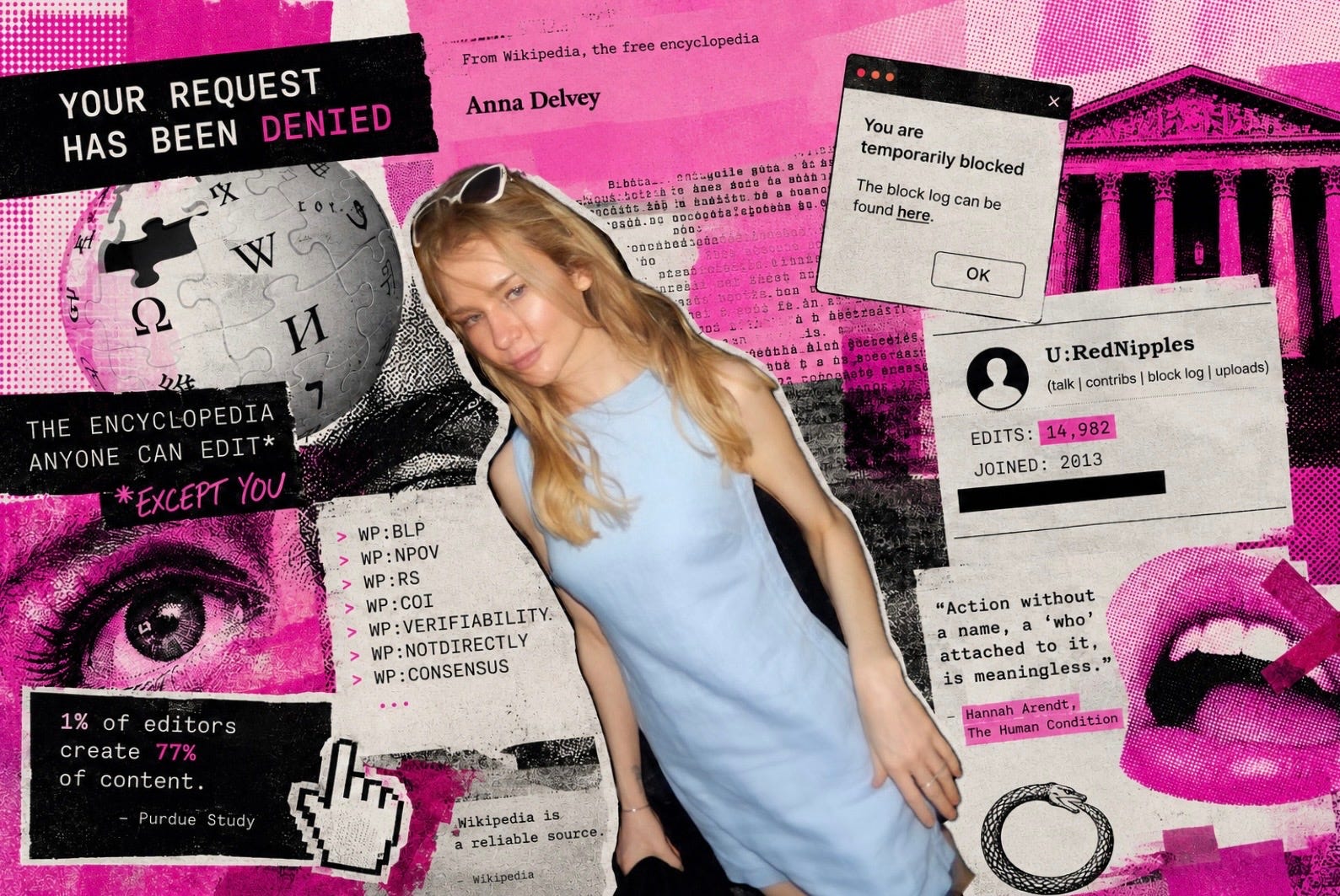
I regret making dinner plans. I’m over half an hour late, and my friend is now drinking alone at the Temple Court bar because instead of getting ready, I’ve been arguing with a Wikipedia editor named User:RedNipples* [redacted]. I have only slightly changed the color of the nipples. The user in question was one of the few who actually ended up being helpful, and my goal here is not to expose him specifically. With a username like that, my wild guess is that he is a man (like ~85-90% of their active editors, depending on which survey you believe), but of course, that is the point - I have no idea.
Like an idiot, I tried following Wikipedia’s Byzantine policies. Since I’ve summoned enough audacity to request changes to my own page (a page that I wish didn’t exist in the first place), under my real name, I can’t be trusted to edit it directly, my only remaining recourse being politely pointing out inaccuracies (degrading insults, if you ask me), while maintaining the temperament of a hostage negotiator, like a beggar hoping to catch the eye of some merciful wikiwarrior who might stumble upon my pleas. I’ve been promptly blocked, unblocked, verified, accused of using an LLM because obviously it’s that hard to believe I’m capable of composing a paragraph about my own moral integrity, ignored, dismissed, accused of using the wrong font, but in the interest of keeping this piece under ten thousand words, I’ll save the full account of my personal Wikiwar in more juicy detail for a separate post. To sum it up: looking at my Wikipedia page really makes me wish I had opened a bakery in Eschweiler a decade ago.
Compared to the Wikipedia kangaroo court, jail was the lesser punishment - at least you sort of know the people, and the sentence has an end date.
Like many people who have the misfortune of becoming the subject of their own WP:BLP (“biography of a living person”, duh! I could hardly resist showing off my freshly acquired command of all the priestly abbreviations), I found it easier to pretend mine didn’t exist.
Would the same type of person who refuses to look at the page that unfailingly appears on top of every Google search about her also, on occasion, go to war over a minor inaccuracy or misspelling in some paywalled village publication, berating some poor sucker for lazy fact-checking and poor work ethic?
Oh, yes.
Until recently, I liked to think of Wikipedia as a relic of the early internet—dated, insular, a niche annoyance that mostly mattered to the unlucky people who managed to incur the wrath of someone identifying as a “wikipedian” and somehow ended up being branded with a biography, or WWE fans. An institution that somehow never closed: still standing, still influential in theory, but easy to assume the world had moved on without. It was easy to laugh off and dismiss. But that was before AI turned it into one of the world’s primary reference points.
When I came across the news of the encyclopedia’s cofounder Larry Sanger’s permanent ban, I went down the rabbit hole of the Wikipedia industrial complex and started to understand the scale of what an anonymous User:RedNipples has the power to affect. (For the sake of brevity, let’s use RedNipples as our token anonymous editor from here on.)
And suddenly, even as someone possessing advanced skill at living in denial, I felt rather extremely inadequate for deleting hours of my life misguidedly harping on inaccuracies in articles nobody could read past the paywall while looking away from the source code. That one page I refused to look at now shapes my Google results, my social media descriptions, my news coverage, my knowledge panels, my podcast introductions, and of course the answers produced by AI. Ask a chatbot who I am, and what you’ll get is in large part just Wikipedia recited back in a different font.
The rules may not have changed much from the crowdsourced epistemic experiment’s perspective, but the world around them certainly has. What may have worked for a volunteer encyclopedia in 2001 no longer works for a major layer of global information infrastructure in 2026.
In the time I spent busying myself with untagging fugly pictures from my Instagram, Wikipedia became the master copy of consensus reality, while retaining governance rules designed for a hobbyist website from the early aughts.
Wikipedia still likes to peddle the democratic fairy tale of "the encyclopedia anyone can edit." They certainly would like you to believe that if so desired, just any rube can swoop in and provide his two cents, that his opinion will matter, and that his account will survive more than three edit attempts without being permanently blocked if RedNipples happens to be feeling sore.
And of course, in theory, anyone can *try* to edit almost anything — all you need to create a Wikipedia account is an email address. Just knowing the option exists should be enough for most people, right? Don’t mind the very high chance the rube’s edit will be reverted, but hey, wasn’t it fun to cosplay as one of the big boys of the basement Politburo? In the end, it’s about the friends we make along the way.
The scale of this oligarchy is not a secret (even though I’ve yet to meet anyone who cares as much as I do) - a Purdue study that crawled all 250 million edits from Wikipedia’s first decade found that roughly 1% of editors generated 77% of the site’s content- the lead author describes these editors as driven by a sense of mission “much like political or religious movements”. The English Wikipedia currently counts some 53 million registered accounts. Around 250,000 of them edited anything at all in the past month, and only about five thousand make more than a hundred edits a month. Of the three-quarters of a million registered editors who made at least one edit in 2024, about half were new accounts making their first edit — and, frequently, their last. Sixty percent of registered users never edit again after their first twenty-four hours. It must be the taste of freedom that makes them run for the hills, or maybe a forcefully blocked IP address.
For a site that demands a footnote and a source for everything, the RedNipples of the world certainly go easy on themselves. Editors are required to disclose nothing at all. No great shock then that accountability hovers somewhere near 4chan’s.
“Without the disclosure of the agent in the act, action loses its specific character and becomes one form of achievement among others… Action without a name, a ‘who’ attached to it, is meaningless.”
— Hannah Arendt, The Human Condition
Having browsed through quite a few editors’ pages (purely for research purposes, of course), I was unprepared for all the cheery goofiness and ill-advised attempts at comedy. Wikipedia has always struck me as a rather somber place. Its custodians, apparently, disagree. Some of their pages read like private standup practice - bits, riffs, entire routines - auditions for SNL held in their parents’ living room.
Note my restraint: I’m naming no names — not for lack of material, but because I’m doing my best to keep this installment friendly and neutral (WP:NPOV, hello), saving the acrimony for the follow-up.
Hate to make this about myself, but: I never asked for this atrocious page to exist. I would be perfectly content for it not to. I cannot delete it, opt out of it, or require the people maintaining it to identify themselves. It stands as a permanent monument to choices I’d rank among neither my greatest achievements nor my most interesting mistakes. The nearest analogy I can think of is the wrist tattoo I got at 19 in Berlin, except the comparison flatters Wikipedia, because the tattoo I can laser off whenever I get around to it. The page is there until the internet isn’t.
It belongs neither to me nor to any publicly accountable editorial institution. It belongs, in practice, to whoever is sufficiently persistent, procedurally fluent, and terminally available to prevail. And god forbid any of them be on my payroll — Wikipedia reserves its greatest suspicion for the one form of influence that comes with a paper trail (WP:COI).
And now, the closest thing I have to due process is the mercy of RedNipples.
In Part II: Why “reliable sources” aren’t, and how Wikipedia cites its own echo as independent proof.
“Master copy of consensus reality” is exactly the right phrase. The institution changed less than its position in the information ecosystem did.
@Jack Despain Zhou